
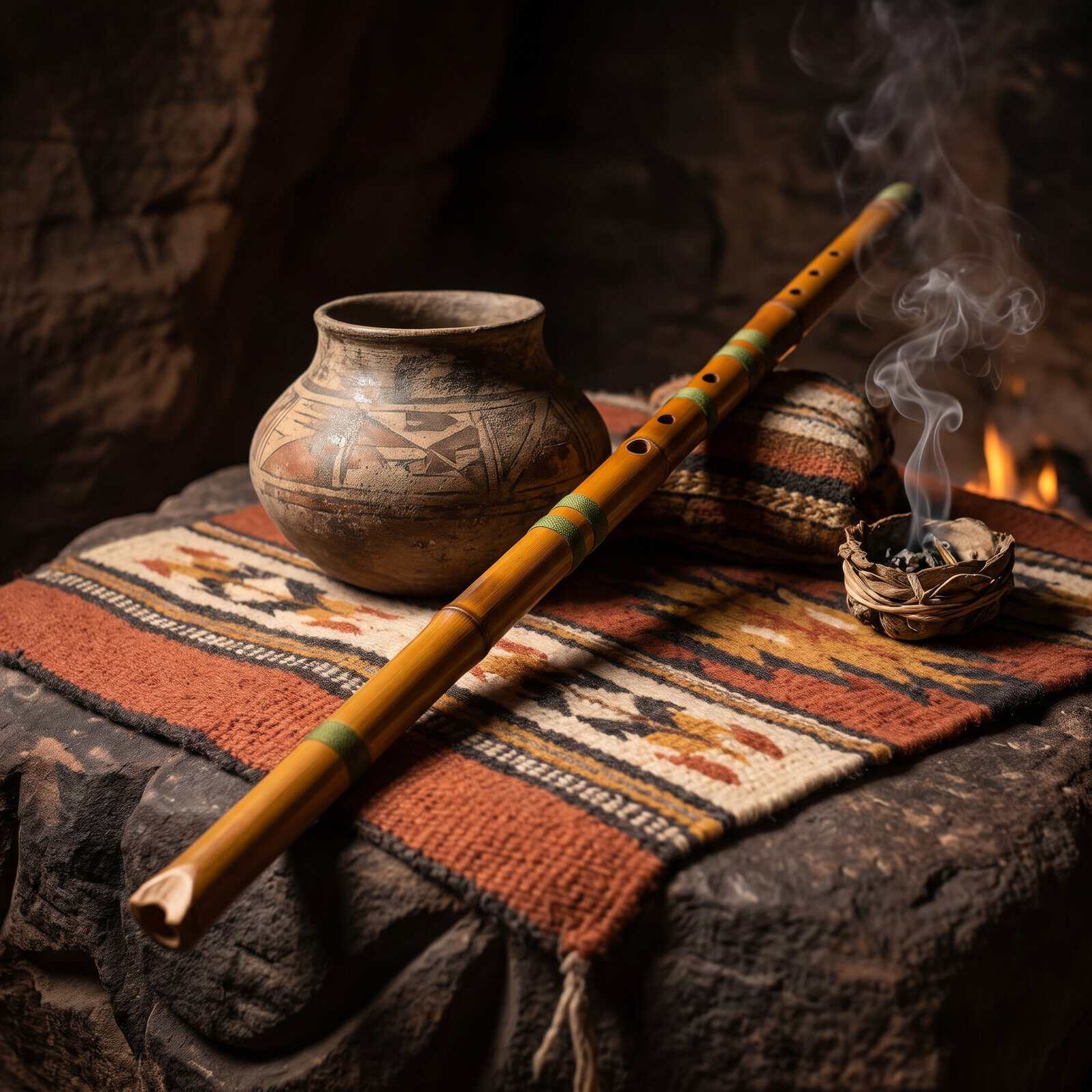
Flauta Pueblo sobre tecido geométrico indígena com cerâmica ancestral e fumaça de sálvia
THE SYMBOL · CHACO CANYON & BROKEN FLUTE CAVE

Before the whistle, the free wind on the edge

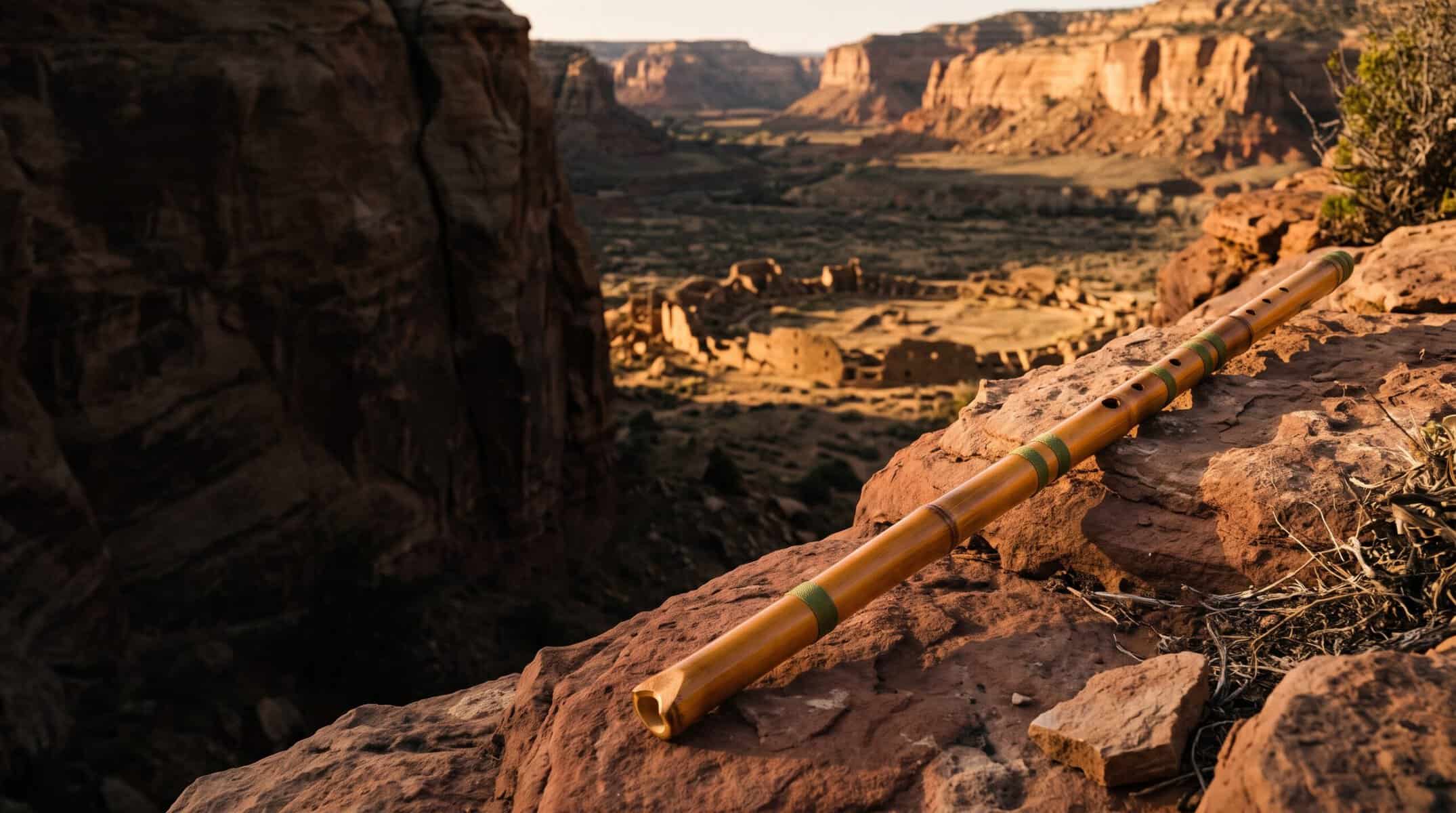
Unlike the modern Native American Flute (NAF) with an internal block, the ancestral flutes excavated at Broken Flute Cave (Arizona, 620–670 AD) and Pueblo Bonito (Chaco Canyon, New Mexico, 690–944 AD) are vertical rim-blown instruments.

Based on archaeological research cataloged in Flutopedia, the three Ashar variations — Anasazi Style, Hopi Style and Mojave Style — are a contemporary reinterpretation and respectful homage to this lineage. While the original specimens from Broken Flute Cave were carved from solid box elder wood (Acer negundo) and Hopi, Mojave and Pueblo Bonito traditions also employed river cane (Phragmites) and native woods, we translate this rim-blown geometry into bamboo treated in our workshop.

Sonic archaeology of North America translated into artisanal bamboo.
THE MUSICAL TRADITION · RIM-BLOWN

The closeness to the Shakuhachi and microtonal control

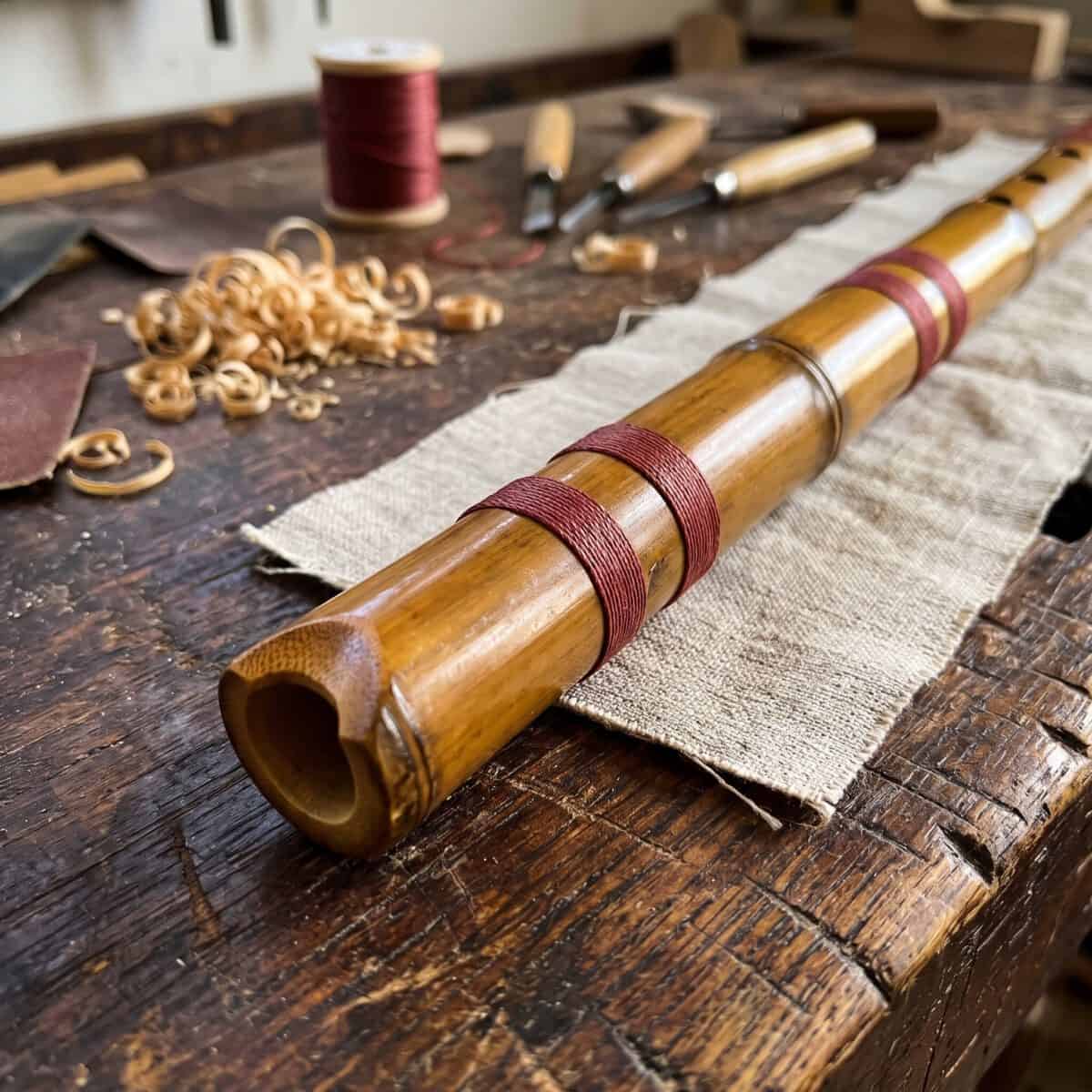
Built from selected thick-walled bamboo, shade-dried for at least 6 months and sealed with natural Indian shellac, our Pueblo Flutes bring a contemporary construction choice at the mouthpiece: while the original archaeological specimens had only an open edge with minimal chamfer, at Ashar we carve the chamfered mouthpiece with reference to the utaguchi of the Japanese Shakuhachi — facilitating sound emission and expanding the depth of the harmonics.

This open embouchure allows for microtonal subtleties, expressive bends, harmonics derived from the root note and 2 full octaves — delivering an organic voice that rewards those who dedicate themselves to mastering rim-blowing.

No rear thumb hole: all expression is born from the breath and the front holes.

Detalhe artesanal do bocal chanfrado de sopro de borda rim-blown em bambu na bancada de lutheria
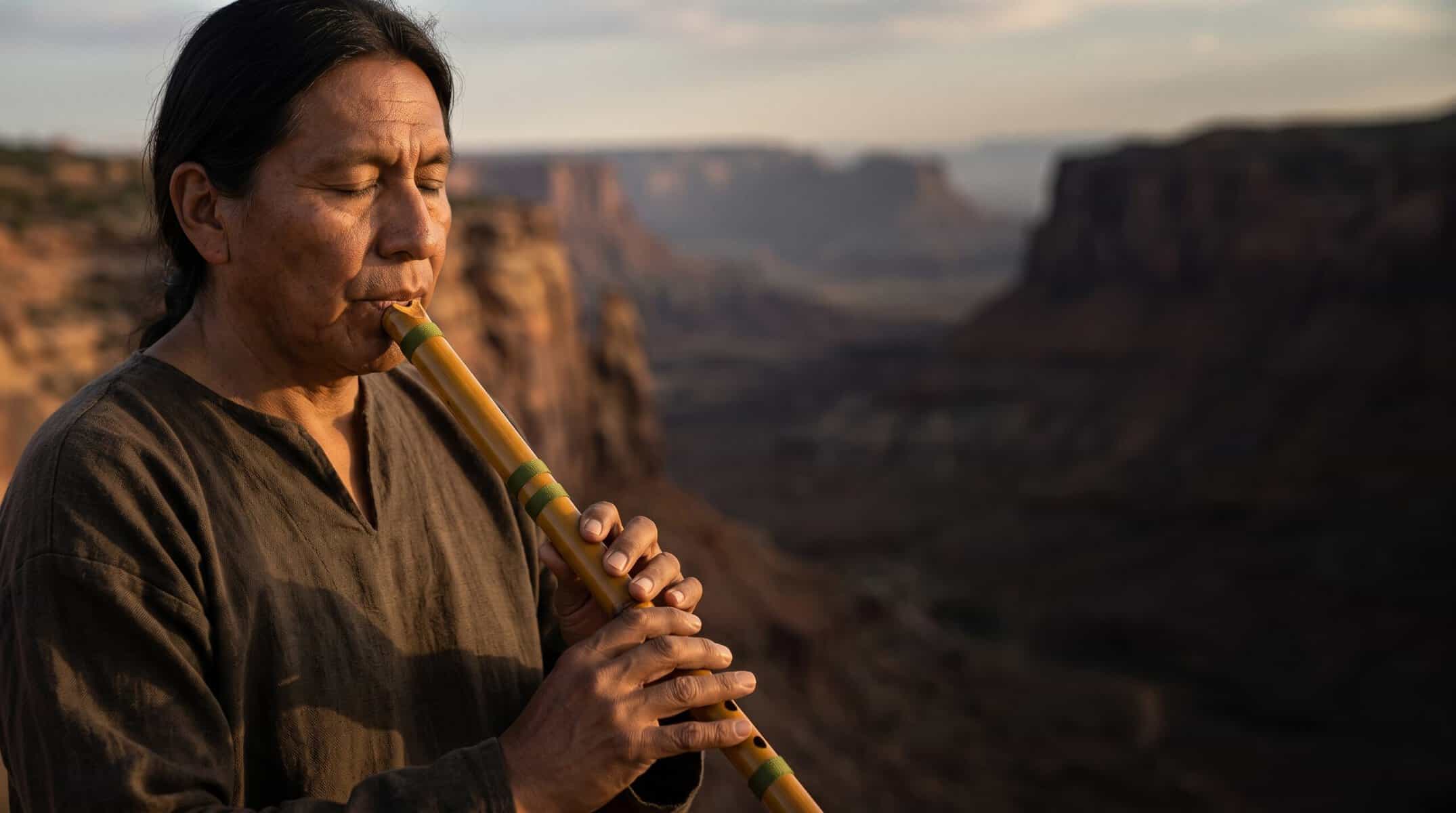
Músico tocando flauta Pueblo vertical de sopro de borda diante dos cânions ao entardecer
SONIC EXPERIENCE

Three models, two low tunings and three personalities

Anasazi in Low G (G) · Hopi and Mojave in Low B (B).

Anasazi — Low G (6 holes, ~80 cm): the largest and lowest of the family, with a deep, cavernous voice inspired by Broken Flute Cave; it favors the Major Pentatonic and archaic minor variations.

Hopi — Low B (5 holes, 64 cm): omits the 5th hole for a direct, clear and ceremonial Major Pentatonic. Mojave — Low B (6 holes, 64 cm): combines the ergonomic length of Low B with the versatility of 6 holes to alternate between Major and Minor Pentatonic.

The Breath of the Pueblo Flutes

The wind of ancient canyons in three bamboo expressions.

THE ASHAR PUEBLO FLUTES

Choose your Pueblo Flute

Explore the three models inspired by the American Southwest — Anasazi (Low G · 6 holes), Hopi (Low B · 5 holes) and Mojave (Low B · 6 holes).

G Baixo
(2) Nok 1,194.00
Previsão de Envio: 12 Feb 2027
B Baixo
Nok 952.00
Previsão de Envio: 12 Feb 2027
B Baixo
Nok 1,021.00
Previsão de Envio: 12 Feb 2027

Each Pueblo Flute is created to order to honor the free rim-blown breath.

Discover all models in the Pueblo Flute category

For greater low-end breadth and archaic atmosphere, we recommend the Anasazi (Low G, 6 holes). For more compact ergonomics in Low B (B), choose Hopi (5 holes, Major Pentatonic) or Mojave (6 holes, Major and Minor).