$
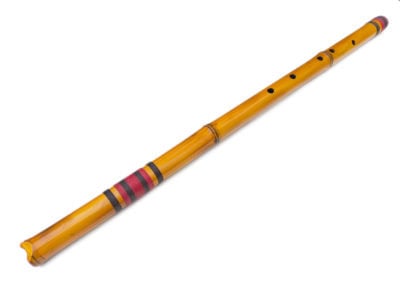
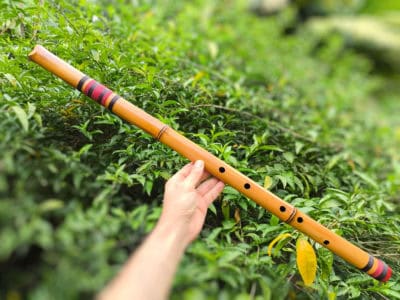
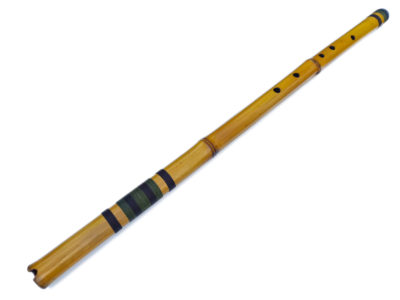
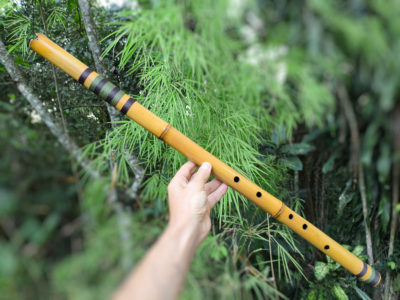
$The earliest examples of Xiao flutes, which bore similarities to current versions, date from the Han dynasty (206 BC - 220 AD), representing a period about 500 years earlier than the first Pueblo flutes of the Americas. At the Nanjing Museum, it is possible to find a clay statuette depicting a musician playing the Xiao, dating from the Han period. It is believed that these flutes were initially imported from the Qiang culture, located in the northwest of Sichuan province, also known as Szechwan, a region that was part of the Silk Road. Merchants who traveled this route often carried flutes with them, and this possibly made them one of the trade items of the time.
Before the Tang dynasty (618-907 AD), any flute made from a single tube was commonly called "di". The term "xiao" was reserved to designate a set of tubes joined together similar to a pan flute. As the Tang dynasty progressed, the transverse flute gained increasing popularity, and from that point on, the name "di" became associated primarily with transverse flutes. Meanwhile, the term "xiao" began to be used to describe a vertical flute, and the Chinese pan flute became known as "paixiao," which can be translated as "line of xiao". However, it was only during the Ming dynasty (1368-1644) that the name "xiao" became established as the standard designation for the specific instrument we have today.
Variations of the xiao include the qinxiao, which is a narrower version, and the shorter and chubbier southern version, called nanyin dongxiao ("carved flute with southern sound") or nanxiao, from Fujian and Taiwan, which was imported to Japan in the 14th century and later became the Shakuhachi.
Traditionally, xiaos are used as a solo instrument or combined with a guqin, a Chinese zither. The sound of the xiao is rich and smooth like a Pueblo (Anasazi) flute, but softer, with less wind and air noise. Xiaos can also play two octaves. Original text by Scott August, a master in the art of playing the Xiao flute and Pueblo flutes.