



 $
$
Have you ever stopped to observe the beauty and simplicity of bamboo? This fascinating plant has much to teach us about how to live a better life. If you are seeking serenity and balance, the path of bamboo may be the answer to transforming your life. Discover the essence of this incredible plant and learn how to apply its teachings in everyday life.
Find Strength in Flexibility
One of the most remarkable characteristics of bamboo is its flexibility. Even when facing strong winds, bamboo bends without breaking, showing us the importance of being flexible in the face of life’s challenges. By adopting this flexible mindset, we can adapt to changes and find creative solutions to the problems that arise on our path. Learn from bamboo to be resilient, to bend instead of break, and you will discover that you can face any storm with serenity and balance.
Cultivate Patience
Bamboo is a plant that grows slowly. However, its patience is rewarded with rapid and vigorous growth when conditions are favorable. Like bamboo, we must learn to cultivate patience in our lives. We cannot rush the process of personal growth and transformation. It takes patience to develop skills, achieve goals, and find true inner peace. By embracing patience, you will learn to live in the present moment and appreciate each stage of your journey.
Be Firm in the Roots, Flexible in the Branches
Bamboo teaches us the importance of having strong and deep roots. Without a solid foundation, we cannot sustain growth and balance in our lives. At the same time, we must be flexible and adaptable like the branches of bamboo. Life is constantly changing, and it is essential that we can adjust to circumstances without losing our essence. Find the balance between stability and flexibility, and you will discover the power of living a zen and conscious life.
The Essence of Bamboo
Perhaps the most important lesson of bamboo is its interior, the empty space between one node and another, which makes it light without compromising its strength. Likewise, if we can keep between one node and another all our attention in the seemingly empty space, we will naturally enter a state of lightness, peace, and contentment. The nodes can be feelings, thoughts, memories, emotions, imaginations, etc. An agitated mind only perceives the nodes and the surface, and does not perceive the space that contemplates everything. Bamboo invites us to calm mental activity by emptying ourselves to increase the space between one node and another, between one thought and another.
Bamboo is a remarkable renewable resource. It is a material that for centuries has been and continues to be used by more than half of the world’s population for applications as varied as food, shelter, fuel, and clothing. These applications make bamboo a vital non-timber, non-petroleum resource. With a tensile strength superior to steel, it is one of the most versatile and durable natural resources in the world.
Bamboo is sustainable! and plays an important role in reducing wood consumption, environmental and forest protection, poverty alleviation, and sustainable development of rural economies. It is the fastest-growing canopy for the reforestation of degraded lands and releases 35% more oxygen than equivalent wooden supports.
Bamboo is highly renewable. It is one of the fastest-growing plants on Earth. Bamboo does not need replanting, grows without fertilizers or pesticides, and is harvested from controlled stands with an incredible three to five year growth cycle. Bamboo is not a wood, but a type of grass. Bamboo offers vital economic and ecological benefits to the lives of millions of people worldwide; providing food, fuel, housing, furniture, craft products, and soil and water conservation.
Bamboo Vision
- A long-lasting, fast-growing, and truly renewable resource that does not need replanting.
- A viable and high-yield replacement for wood and petroleum-based products.
- Important economic and ecological benefits, including soil and water conservation, jobs, countless product and food applications, and more than 1000 documented uses.
- A surprisingly short growth cycle; it can be harvested in 3-5 years versus 15-20, typical of many hardwoods.
- The fastest-growing plant on the planet; some species can grow up to 1 meter or 3 feet per day.
- A critical element in the balance of oxygen and carbon dioxide in the atmosphere.
- A renewable alternative resource for agroforestry production.
- Bamboo shoots provide a nutritional food source that can be transformed into bread, cakes, and cookies.
- Ecological reduction of pressure on forests through the replacement of wood.
- Products can be made in rural settings, reducing industrial and urbanization impacts.
- Bamboo is durable, resistant, and strong.
Bamboo Flute
The raw material used to make native flutes varied according to regions. There were flutes made of bone, ceramic, yucca stalk (a type of agave), bamboo or cane, and wood. Currently, wooden flutes are more widely used due to the ease of standardizing production processes with machines. We prioritize artisanal production in bamboo, for several reasons. The first is that each flute is unique; it has a personality, timbre, and voice that will depend on the chosen bamboo and its characteristics, so the artisan must adapt to the material. All native cultures that had geographical access to varieties of canes and bamboos used them to create their flutes, such as the Xiao in China, the Shakuhachi in Japan, the Bansuri of India, the Ney in Egypt, Iran and Turkey, the Quena in Andean countries, and the Native American flute. Bamboo is a sustainable plant; it grows very fast, has high resistance, and with it the production process requires little interference from machines. In the Plant Kingdom, bamboo belongs to the family of grasses and reeds that according to natives are the hairs of Mother Earth; it is a “Giving People” par excellence, and its structure and anatomy are ideal for this creation. Bamboo is a gift from nature.
Bamboo flutes carry many meanings and energies, and one of them is the intimate relationship with the Water element. Bamboo pumps a lot of water to rise toward the sun. Some origin stories of South Amerindian native flutes are related to water spirits, rivers, and fish. The stories and ritual symbolisms of Northern Amerindians, on the other hand, relate flutes to rituals invoking the “Thunder Beings” to bring rain. Likewise, when we play native flutes, we feel a movement within us that is related to emotions — the human aspect connected to the water element.
The River Cane Flute is a vital instrument in the culture and ceremonies of the peoples who lived along the banks of the Colorado and Gila rivers, such as the Navajo, Hopi, Hualapai, among others. In some origin myths of these peoples, a long bamboo cane was used to pierce and allow the passage of beings from the underground world to the surface world where we live. The Hopi, to this day, preserve rituals where the Flute Clan plays.
We work with some species depending on the type of flute and specific need. Our bamboo is harvested with respect, at the appropriate times, dried in the ideal time, and treated in the best way to ensure its resistance and good acoustics. Proper maintenance and care by the flutist will also ensure the durability and quality of this sacred instrument.
The Breckenridge Flute
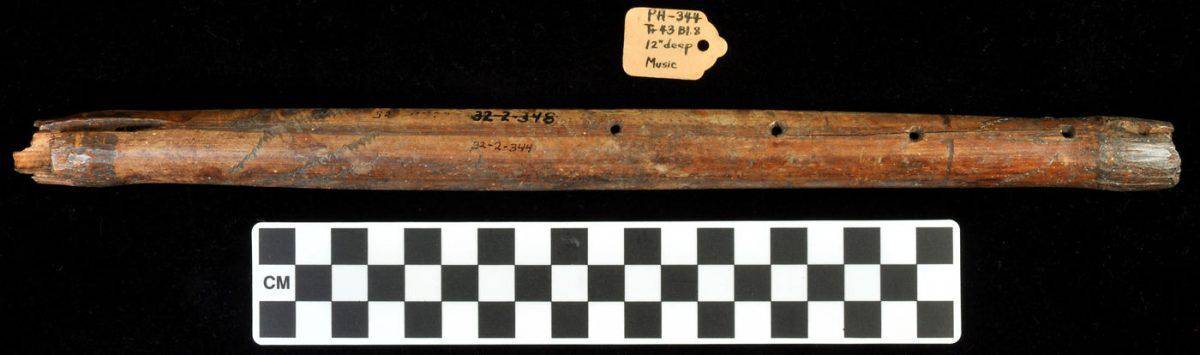
The Breckenridge flute. Photo by Leslie Walker, Arkansas Archeological Survey, courtesy of The University of Arkansas Museum Collections.
The oldest known example of a Native American flute was found in northwestern Arkansas. In the 1930s, Samuel Dellinger, curator of the University of Arkansas Museum, sent teams to excavate several prehistoric cliff shelter sites on the Ozark Plateau. The Ozark Plateau, located in what is now the southeastern United States, was home to Native Americans as early as 10,000 BC until the early 1800s. These excavations unearthed many important artifacts and, due to the extremely dry conditions in many of these shelters, ladders, basketwork, sandals, and plant remains were preserved and collected. Among these artifacts was a small piece of bamboo with holes drilled along its shaft.
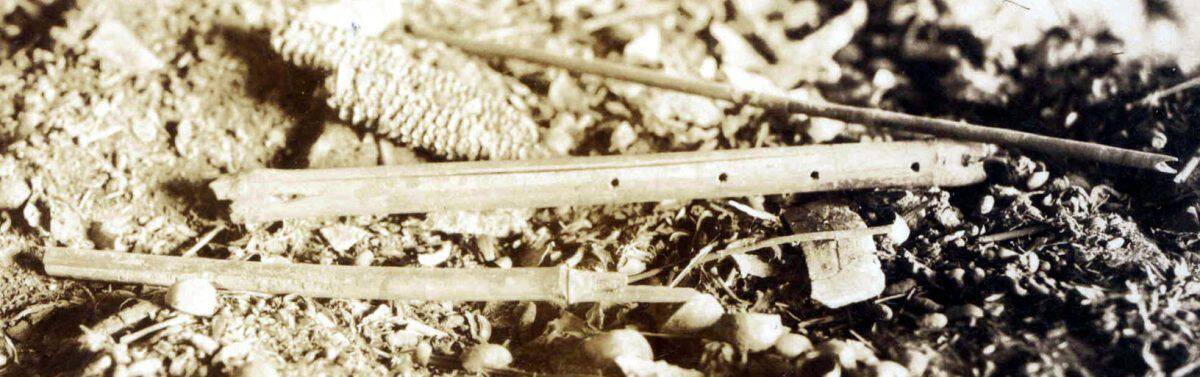
A photographic detail showing the Breckenridge flute in context during the 1933 excavations. Photo from the University of Arkansas Museum.
These artifacts are still curated in the collections of the University of Arkansas Museum. However, the perforated piece of bamboo (river cane) went unnoticed for nearly 80 years among the thousands of specimens from Dellinger’s 1930s collections. In 2011, at the Arkansas Archeological Society, volunteer Jim Rees identified it as a flute. This flute, recovered from the Breckenridge shelter in Carroll County, is a two-chamber river cane (bamboo) duct flute. This is the variety of flute known today as the “Native American Flute“. It is more complicated than a simple duct or whistle, which only produces one note, or a simpler form of flute that has only one chamber and requires the player to blow at the top of the opening. Whistles and simple flutes are played in the way you would blow over the opening of a bottle to produce a sound. Flutes like the Breckenridge flute are more complex. You blow directly into one chamber and the air is channeled over an opening in a second chamber that produces a sound.
Radiocarbon dates place the flute at approximately 900 to 1000 years old. This makes it the oldest flute of its kind found in North America so far.
The path of bamboo is a journey of self-discovery. By adopting the teachings of this wonderful plant, we can find the serenity and balance we seek. Be flexible, cultivate patience, strengthen your roots, and keep a light and serene mind by placing your attention on the space between the nodes.
Imagine the sound of the bamboo flute?
By playing a bamboo flute, all these perceptions are experienced.
