



 $
$In the beginning, God created the heavens and the earth. The earth was formless and empty… God said, ‘Let there be light,’ and there was light (Genesis 1)
Then the Lord God formed a man from the dust of the ground and breathed into his nostrils the breath of life, and the man became a living being. (Genesis 2)
The breath, respiration, sound, the soul. Could it be that when we speak of all these aspects, we are speaking of the same principle? So let’s start from the beginning.
Breath – From Latin ‘spiritu’; From Greek ‘Pneuma’
Spiritu – Meaning – Breath, spirit, soul
Pneuma – Meaning – Breath, spirit, soul
In contemporary medicine, “pneuma” is used as a prefix to name diseases related to the respiratory system, such as ‘Pneumonia’. Could respiratory diseases be diseases of the spirit?
There seems to be an ancient relationship between breathing and our soul. If we observe creation myths of the world and the universe, in the most diverse cultures on the planet, we notice that the “creator of all things” in these ancient stories generally uses sound, breath, respiration, or breath as a tool to create.
In the beginning was the Word, and the Word was with God, and the Word was God. He was with God in the beginning. Through him all things were made; without him nothing was made that has been made. (John 1:1-4)
When studying the science of breathing, the first thing we notice is the fact that it is audible: it is a word in itself, for what we call a word is only a verbal manifestation of the breath produced by the mouth and tongue. Through the skill of the mouth, breath becomes voice, hence we understand that the primordial state of a word is breath. If we say: ‘In the beginning was the breath,’ that is the same as saying ‘in the beginning was the Word.’ The first sign of life known is sound – and sound is also word. (BERENDT, 1993, p. 47)
Word = Sound = Word = Breath = Soul = God
God has an outward voice and is not afraid to use it. But when He wants to be heard, when what He has to say is too important to be lost, He often speaks in a whisper just above the absolute threshold of hearing […] God’s whisper is gentle, but there is nothing more powerful. (Mark Batterson)
The voice of the Spirit is as gentle as the western breeze, so gentle that unless you are living in perfect communion with God, you will never hear it. (Oswald Chambers)
The Whisper is a Breath with a Light Touch of Sound
We can say that the typical use of the whisper is for secrecy. No other form of communication is more intimate. When someone speaks in a whisper, you have to get very close to hear. We lean toward the whisper, and that is what God wants. The goal of hearing God’s voice is not just to hear His voice; it is to have intimacy with Him. That is why He speaks in a whisper. He desires to be as close to us as divinely possible! The Almighty could intimidate you with His outward voice, but He courts you with a whisper. And His whisper is the very breath of life. Is that not how God created Adam? He breathed on the dust and called him Adam. Adam was once a whisper. So are you! (Mark Batterson)
Among the facts there is the whisper. It is the whisper that impresses me. (The Hour of the Star – Clarice Lispector)
God’s breath seems to have given rise to the world, but breathing is also the first action we take when we are born and soon becomes sound through the baby’s cry. It is also the last action we take before dying.
The air is precious to the red man, for all creatures breathe in common – the animals, the trees, the man… The white man seems not to notice the air he breathes. Like a dying man in prolonged agony, he is insensitive to the foul air. But if we sell you our land, you must remember that the air is precious to us, that the air shares its spirit with all the life it sustains. The wind that gave our grandfather his first breath of life also receives his last sigh. And if we sell you our land, you must keep it apart, made a sanctuary, as a place where even the white man can go to savor the wind, sweetened with the fragrance of wildflowers. (Excerpt from Chief Seattle’s Letter)
The Wind is the Breath of the Planet
Breathing, wind, connect animal and plant life, connect earth to sky: animals need oxygen and release carbon dioxide, while plants need carbon dioxide and produce oxygen. Winds carry clouds distributing rain across the planet, balance temperatures, transport seeds, and incredibly, winds carry dust from the Sahara Desert thousands of kilometers to the Amazon forests; its dust is rich in phosphorus, acting as fertilizer for the tropical forest.
Sound is implicit in all human acts. Even motionless, our body is full of sounds: blood running through arteries, heartbeats, digestion of food. In every particle, in every atom, sounds attest that we are alive. Even after death, the disintegration process of the physical structure is marked by dozens of sound emanations. Thus, we find the origin in the magic that surrounds people’s speculations about sound. Since the first act of consciousness of the species, the aspect that drew the most attention was sound, represented by Supernatural Beings. From the wind, the sea, and the rain, sound was the aspect that most instigated the human mind. The need to unveil these mysteries made man train his voice and body to reproduce these magical sounds and, thus, communicate with the gods through songs, mantras, whistles, musical instruments, and the most diverse creations that imagination allowed. In this evolutionary act, when societies began, man created codes to communicate. From breathing, words arise, sound becomes complex and gains meanings.
Always the acoustic element intervenes in the creation of the world, whether in the form of a howl (belief of the ancient Egyptians and some primitive African tribes), of breath, or of vocal sounds, manifested in the most diverse sound possibilities.
In mythologies, the creator God presents Himself in the most different forms. In Africa, Mulungu, creator god of the Kamba, is a flute, just as for the Japanese. Among the Kato, Pomo, and Yuki of California, God is a great snore; For the Egyptians and Chinese, the creator is a crocodile, who beats his belly with his own tail, that is, he is a drum. This instrument also appears venerated in Asia Minor, as the God Ea or Enki. In the Caucasus, the earth was separated from the sea by the breath of two tubes; in Japan, a sacred reed gave rise to the creator.
The Upanishads (Sacred Scriptures of Hinduism) do not tire of repeating to us that the sounds OM or AUM are “immortal and intrepid” syllables that create the world. There is a coincidence between the creation myths of Hindus and Christians. OM is the Word. Among the Chinese, Hindus, and Christians, there is also unity: in both cultures, creation myths arise from sound emanation. The earthly manifestation of the Chinese “Single Origin,” the Hindu OM, and the Christian Word is similar, an audible vibratory wave on our planet. The book of the Vedas says: “In the beginning was Brahma, with whom was the Word. And the Word is Brahma.” The Tibetans say: “In the beginning was OM.” The Gospel according to John says: “In the beginning was the Word, and the Word was with God, and the Word was God.” These quotes confirm that God created the universe through a vibratory emanation. The most diverse archaic cultures use variants of the syllable OM to express this vibratory emanation. “The Cosmic Sound, impregnated with the essence of Consciousness, has been variously known as AUM, AMN, AMEN, AMEEN, OMEN, OMON, I AM, HU, YAHUVAH.”
The Sumerians believed that the gods had created the universe with their “powerful orders.” Similarly, life and matter were created through a word or sacred words pronounced by the first god or gods, in the myths of the Hebrews, Celts, Chinese, Egyptians, American Indians, and the Maya-Quiché […] The same idea reappears in the Pythagorean concept of the Harmony of the Spheres, a concept that exerted considerable influence in the early Christian and medieval eras. (Ibidem, p. 224)
Marius Schneider cites that, in Aztec mythology, the creator was motionless and inaudible. Tired, he threw the mountain far away and broke his silence to create the world and human beings. “Then he sang: Let the world be made! And the world was made.” In the Christian religion, the “Book of Genesis” shows that, with each order uttered by God, an element of the universe is created. That is, the element is created by the vibratory emanation of the given order, by the action of sound.
A legend among Tibetans says that the act of creation arose from the wind, which, as it sounded, transformed into various forms.
In the beginning, there was the wind. With its agitation, it created the gjatams, the primeval forms, and the first foundation of the world. The wind sounded, and as sound, it formed matter. The sounding of these first gjatams developed new forms that, by virtue of their sounds, in turn created other forms[…] (Ibidem, p. 221)
According to cosmogonic myths, under the most diverse forms and metamorphoses or using wind or percussion instruments, the creator God and his assistant gods used sound to perform the act of creation. From breathing, an essential element for life, the stagnation of waters, the darkness of night, or contemplation was interrupted, so that all forms and living beings were created through sound. Whatever the form used or transforming instrument, the act of creation is always described as an acoustic phenomenon. To this day, among aborigines and mediumistic sects, there is a belief that contact with the gods is made through magical words, which give shamans, medicine men, and mediums the power of healing and the ability to reach altered states of consciousness. According to Hindus, the creationist syllable OM is the essence of sáman (chant) and breath. OM is the primeval mantra; from this syllable, all matter of the world progressively arose.
For them, it is essential that this syllable be chanted constantly so that there is balance between these forces and that, consequently, life itself on earth and all beings upon it remain in balance. Therefore, by keeping cosmogonic myths alive in memory through chants and mantras, the various sects and mantra cultures renew the symbolic consumption of these archaic cultures, keeping them alive and bringing new meanings.
In Taoism, breath is called Qi, linked to vitality; it is the creative and preserving force of life. Written language in China is represented by symbols, or ideograms. The etymological meaning of the Qi ideogram in its most well-known traditional form is an image of “steam rising from rice while it is being cooked.” Qi is often translated as “air” or “breath.”
Most Chinese alchemy teachings recognize that Qi is a type of metaphysical energy that surrounds, permeates, and exists in nature and in all beings: that is, Qi is the “breath of universal energy” existing in everything and everyone.
The intermediate space between heaven and earth is filled with a breath, the Qi, in which man lives, just as a fish lives in water. This same intermediate or subtle area is, in India, called Vayu (wind or vital breath, the God of wind). Vayu is the thread (sutra) that connects all worlds to each other.
The structure of the microcosm is identical to that of the macrocosm: Just as the universe is connected through Vayu, man is connected by his breaths, pranas,… which govern vital functions and not only the respiratory rhythm. (CHEVALIER, 2009. p.850)
Ajayô – “is an African expression that means breath of greeting to Oxalá. It is often spoken with a meaning similar to the expression ‘God willing’ or ‘hopefully’ and is used to greet someone.”
Yoruba Cosmogony
As in every culture, Yoruba cosmogony also has its theory about the creation of the world, beings, and the role of deities in this episode. The great God of creation is Olorun, the supreme God. In the moment before creation, all that existed was an infinite mass of air. Such mass was Olorun himself. By moving slowly and breathing, Olorun gave rise to water. From the relationship between water and air, he created the Great White God, Oxalá, a deity representing aspects of masculine energy. From the relationship between air and earth, Olorun gave rise to Odudua, a deity representing aspects of feminine energy. In the constant movement of water and air, part of this matter solidified, giving rise to a mound of reddish earth, onto which Olorun breathed his breath and also the divine air so that Exu was born, the first living and individualized form of the universe. Odudua created the world, and Oxalá created man, woman, and all beings. At that time, the sky was not separated from the earth, and men and gods moved freely between the two worlds. But a peasant disobeyed a rule imposed by Oxalá, who became angry and at that moment separated the two worlds, creating a new relationship between men and deities. Between heaven and earth, a gap formed, and this gap was filled by Olorun’s breath, giving rise to the atmosphere.
Guarani Cosmogony – The Breath of Tupã
In the Guarani creation myth, in the beginning, the god Tupã lived in the void, in endless darkness. First, Tupã created the sky and the stars, where he made his home, and below, he created the waters. Then, Tupã descended from above in a great whirlwind. As soon as Tupã touched the waters, the sun appeared in the arch of the sky. When the sun reached its highest point, its heat cracked Tupã’s skin. And finally, when the sun disappeared on the other side of the sky, Tupã’s skin fell from his body, spread over the waters, and formed the lands. The next day, the sun appeared in the sky and noticed the change. The sun reached its highest point again, and Tupã took some clay, kneaded it, and shaped the first Man. He breathed into his nose and gave him life. The Man grew and became as great as Tupã, but he did not speak. The great god breathed into his mouth, and he began to speak. Then, Tupã breathed intelligence into his left ear and wisdom into his right ear. On the Man’s head, Tupã drew the sacred rays and thunders that are thoughts. In the Man’s body, Tupã placed the waters of emotions and desires that move to create or destroy. Finally, Tupã gave Man the power to choose between creating and destroying. Creation complete, Tupã returned to the sky riding his whirlwind.
Among indigenous peoples across the American continent, breath has strong representativeness in the most diverse daily activities. But mainly, breath is used in sacred ceremonies, in protection and blessing works, and can even be used as a remedy to cure imbalances, relax, and also provide journeys through different states of consciousness.
Rapé
Rapé is a powder made from crushed herbs and tobacco, used by indigenous peoples, mainly Brazilians. Used to treat imbalances, relax, and also used in ceremonies as a form of prayer that invokes the forces of nature, the blessing of forest animals, and the power of medicinal plants to heal us and give strength; it is important to use this substance in a respectful environment focused on healing. Rapé is known as a breath medicine, as its application is carried out by blowing this medicine into the nostrils. This application is done with an instrument called Kuripe or Tepi, made from small pieces of bamboo or bone, allowing self-application or application from one person to others. Part of the power of this ritual comes from the breath itself and the potential of the one who applies it. Generally, the person responsible for the application invokes, through song and prayer, the energy of an animal kingdom spirit to bless that breath, so that the blown energy receives, in addition to the remedy stored in the powder, the power of such a spirit capable of bringing the balance and harmony necessary for the healing of the one who receives it.
Among the Hupd’ah peoples, nomadic or semi-nomadic peoples of the Upper Rio Negro, inhabiting regions between Brazil and Colombia, shamanic or healing practices are always related to breath. The Blessers or Shamans master this communication tool distinct from everyday language, which is breath and murmur. During the practice, enchantments are performed, and the Shaman travels through different dimensions through his “breath-person” (Spirit), to seek harmony of the spirit of the person being healed.
The Chanumpa
The sacred pipe of the Lakota people (Chanumpa) of North America plays a fundamental role in the spiritual and cultural life of this people. The symbolism and rituals of the sacred pipe provide the foundations of spirituality in the rich Lakota tradition. However, this ceremony is inseparable from the moral preparation and spiritual reflection of each individual, making the pipe an important symbol present throughout the life of a native of this nation.
The Flutes
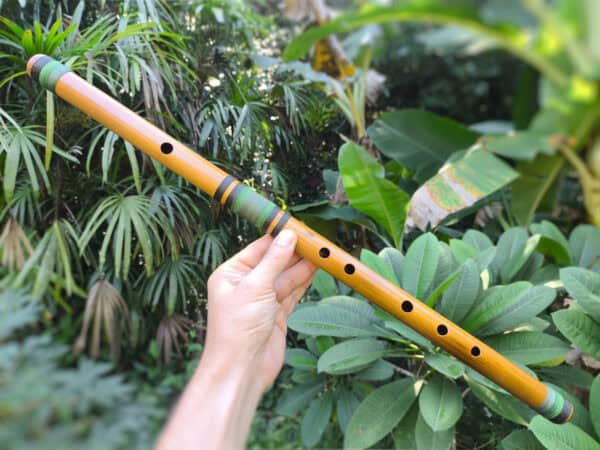
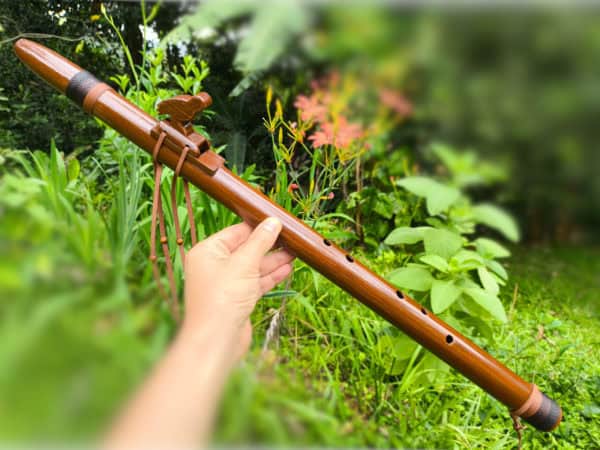
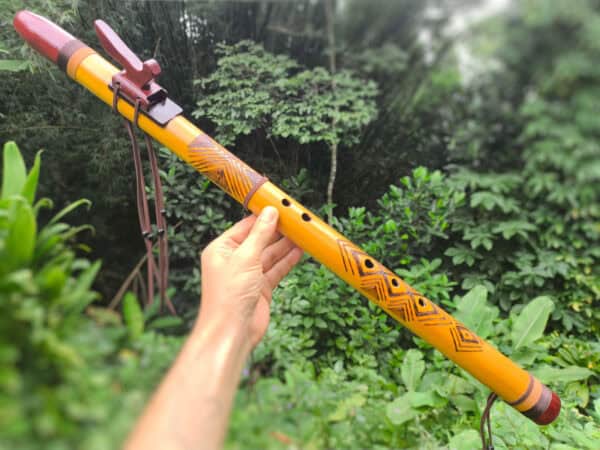
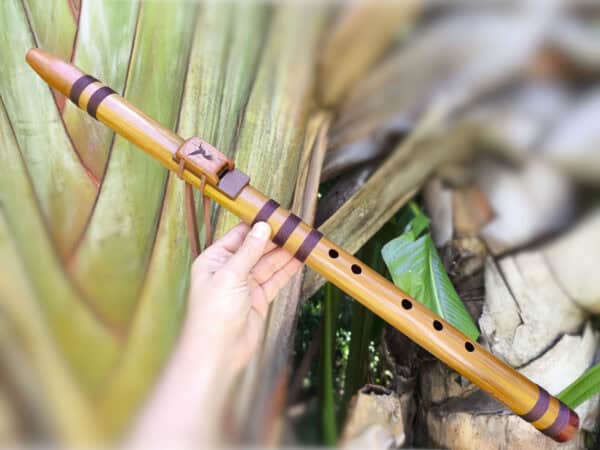
Flutes are common instruments among native peoples throughout the Americas, seen as symbols of fertility. From North America, with its frontal whistle flute, to the peoples of South America with their enormous harmonic flutes without holes, and the Andean peoples with the Quena flute, ceramic flutes, and Pan flutes. The music coming from breath is intimately related to these peoples and their sacred ceremonies.
THE MUSIC OF BREATHING
The world we live in is composed of dualities. For Taoism, these dualities are called Yin and Yang, which can also be understood as feminine and masculine, as negative and positive. Breathing is also dual, as at one moment we inhale and at another we exhale. This same dual rhythm is present in the heartbeat. But in the world we live in today, society has been unlearning how to breathe. There are so many activities, so many visual interferences, so much stress, that everyone lives without time, and their breathing seems to oscillate in rapid intervals of chest breaths. Society has unlearned to breathe calmly, calmly filling the abdomen and drawing it back in an equally slow rhythm during exhalation.
For Yogis, breathing is life itself, and the slower your breathing, the longer you will live. When we understand that our body is constantly producing music and observe the rhythm of this music, we begin to understand our state of mind. In all Hindu and Buddhist culture, breathing is one of the most important cares, because when we keep our breathing calm, we calm the entire rhythm of the body, and its body music comes into harmony. That is why when we see an agitated or upset person, it is common to say “take a deep breath.” For a deep breath instantly changes your state of mind.
Our breathing is an extremely powerful tool, but we can add new ‘powers’ to it when we use it consciously. The voice is the representation of our breath of life; it is one of the ways to add powers to breathing. And these powers can be added in different ways:
- Breath is breathing itself;
- A blow is a driven breath with greater power. (It can also be used through musical instruments and other tools)
- Breath leaving in the form of sound is the most powerful way to use your breath.
Wind instruments are thus present in all ancient cultures of the world. Flutes with 4, 5, 8, even without holes; Dungchen, the giant trumpets played by monks atop temples in Tibet; The powerful transverse flute of Hindus, the Bansuri or Venu; Ceramic ocarinas thousands of years old found at archaeological sites in China. Shakuhachi, the Japanese flute made from bamboo root; The Didgeridoo, an Australian Aboriginal instrument from which sound is generated by the vibration of the lips.
Chants, mantras, and musical instruments that require intense breathing exercise are important tools to aid in the development of mental, bodily, emotional, and spiritual health. For Hindus, singing is the most powerful art that exists, and in their culture, singing goes beyond technique; it is an experience of finding your own sound and tuning in with it. In sacred ceremonies of all ancient peoples, chants and wind instruments are present. Thus, it is not difficult to understand why Asian peoples present an ancient knowledge of the powers of breathing, breath, whisper, and chant. Their techniques go beyond predefined rules, but the most precious rules are – to follow intuition and to practice the science of breathing.
References:
- Cover Art by: Archenti Flores
- Whisper: How to Hear the Voice of God – Mark Batterson
- The Origin of the Universe and Sound Myths – Marcos Júlio Sergl
- Ajaiô
- Yoruba Cosmogony: the creation and separation of the world
- Qi
- Rapé
- Paths of Breath: shamanic discourse and forest paths of the Hupd’äh – Danilo Paiva Ramos
- Guarani Mythology – The breath of Tupã – Source: CLARO, Regina. Encontros de história: do arco-íris à lua, do Brasil à África. São Paulo: Cereja, 2014, p. 4.
- Sacred Pipe of the Lakota Sioux
- HAZRAT, Inayat Khan Sufi. Music



What a beautiful post ! Thank you so much for sharing this wisdom and research with us. 🙂 I intend to come back to this numerous times and reread it to digest and process this on a deeper level.
Inspirant. Quelles est le rôle des pensées ?