$
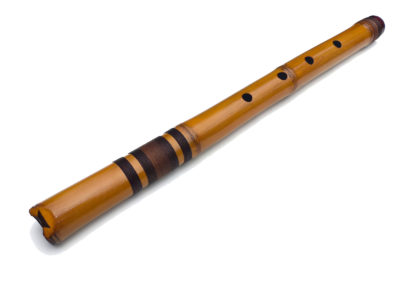
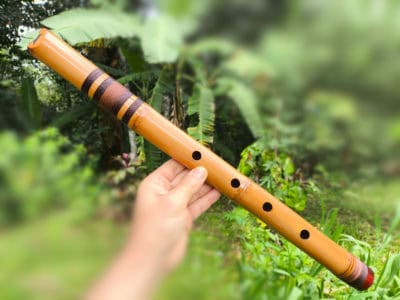
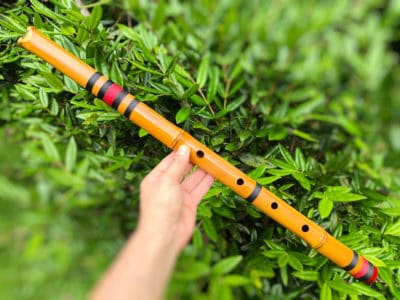
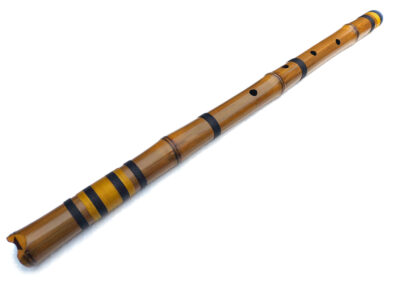
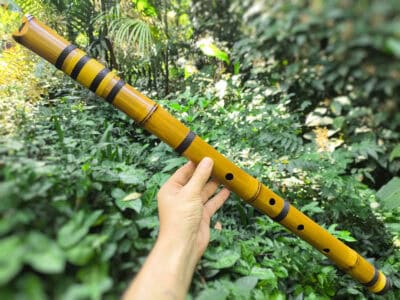
$The Shakuhachi (kanji:尺八); also known as take (kanji: 竹) is a Japanese flute that is held vertically like a recorder, rather than held transversely like the familiar Western transverse flute. A recorder blows into a duct, also called a "fipple" and therefore has limited tuning control. The shakuhachi player blows as if blowing across the top of an empty bottle, but the opposite edge of the shakuhachi has a sharp edge, allowing the player substantial pitch control. The five finger holes are tuned to a basic pentatonic scale without semitones, but the musician can bend each tone up to a whole tone or more. Shakuhachi is made from the root of a bamboo stalk and is an extremely versatile instrument. The holes can be partially covered (1/4 covered, 1/2, 2/3, etc.) and the tone can vary subtly or substantially, altering the blowing angle through skillful embouchure control. Professional musicians can produce virtually any note they wish from the instrument and play a broad repertoire of original Zen music (honkyoku), ensemble music with koto and shamisen (sankyoku), folk music (min'yo) and contemporary music.
The name shakuhachi is derived from its size: 1.8. It is a simple compound of two Japanese words: The word "shaku" 尺 meaning "foot" (as in English, both anatomical and as an archaic measure of length), which was approximately equal to 30.3 centimeters and subdivided into ten. The word "hachi" 八, in Japanese means the number 8, but here means eight tenths of a foot. Thus, shakuhachi literally means "one foot and eight inches"; (almost 55 centimeters), which is just the standard length of a shakuhachi. Other shakuhachi vary in length from about 1.3 shaku to 3.8 shaku. The longer the shakuhachi, the lower the basic pitch with all holes closed. Although the sizes are different, they are all still generically called shakuhachi. The bamboo flute first came from China and Korea to Japan and was first used in gagaku (imperial court orchestra). The shakuhachi proper, however, is quite distinct from its continental ancestors, the result of centuries of isolated evolution in Japan.
Shakuhachi music uses many sounds that do not fit into the popular vocabulary of Western music. It makes active use of "non-musical" sounds or noises, such as breath, wind sounds, simulated animal sounds, as well as no sound, space, silence, which is a very important element and symbolizes emptiness, selflessness, the basis of the Komuso life motto "Coming from nothing, going nowhere like the wind". Learn more here!