



 $
$Article inspired by Judy Epstein Buss’s thesis on the presence of the flute in the culture of the indigenous peoples of North America. This study provides an important link to understanding the traditional use of the flute and the music played on flutes in North American indigenous cultures. This thesis was written in 1977.
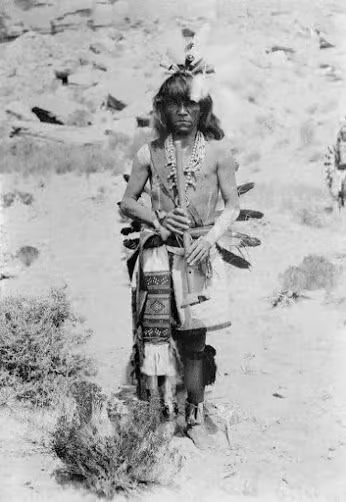
The flute played an important and unique role in the culture of North American Indians. With the drastic changes these cultures underwent since the 1930s (frequent displacement, diffusion, and acculturation), many cultural traits disappeared wholly or partially, among them records about the flageolet (a wind instrument of the flute family). Consequently, this study is almost entirely based on material collected before 1935.
Apparently, the making and playing of flutes was a privilege of a few among indigenous peoples, so many records about this instrument were lost. The same did not happen with songs and stories, as they were passed down orally and shared by all, which greatly helped in their preservation.
The diversity among Native American peoples was so great, so many beliefs, stories, myths, rites, that sometimes within the same village one found accounts and descriptions of their own culture in different versions. This study was a great challenge for the researcher to gain a complete understanding of the place of the flute in American indigenous culture.
In folklore, stories, and records about North American indigenous culture, flutes, whistles, and flageolets were vaguely mentioned. Due to the fact that those responsible for such records were not musicians, they did not take into account the difference between these instruments. For this reason, in this study, the term “flute” will be used to refer to these instruments in general.
The Role and Meaning of the Flute in North American Indigenous Culture
Despite the great variation among cultures, the flute seems to be almost universally seen as a phallic symbol. Worldwide, the flute is associated with fertility, birth, life, and death and is used in various rituals centered on these matters.
American indigenous culture produced a rich variety of mythologies and legends about the origin of the flute that demonstrate its supernatural power. The boundaries between myth and real life became blurred. Thus, in rituals linked to the flute, one witnesses a curious synthesis between the two.
The flute seemed to particularly represent male fertility in North American indigenous culture. According to mythology, as well as ethnographies gathered across North America, it becomes evident that flute playing was restricted to men only. Even in the Corn Grinding Ceremony of the Pueblo Indians, a ritual performed only by women, accounts describe a man playing the flute to accompany the women’s singing and dancing.
In all the material examined, only one example was found citing a woman playing the flute, and in this case, the purpose was to teach a boy to play it. This example is in the book “The Story of the Origin of the Flute.” (Frances Densmore – 1867–1957)
Flute making did not seem to be restricted to men. Myths reported that flutes were made by Shamans and dreamers, men and women, who were believed to have direct contact with the supernatural and were able to attribute magical power to the flute. Numerous examples of women who made flutes can be found in mythologies, but there is no concrete historical evidence of this role of women in the universe of flutes of the Native peoples of North America.
The legends illustrate themes such as: the nature of magical powers linked to the flute, the power this instrument has to control the weather, to attract women, as well as its use as a means of transportation.
An example that especially brings to light the magical power attributed to the flute is found in Apache myths and tales. The flute becomes a means of transportation, a fact that Goddard states:
“…it is one of the recognized methods of rapid transportation” (Goddard 1919)
In various versions of the story “The Creation Myth,” a man who was searching for his missing wife used the flute to travel through the mountains:
“He departed, traveling with a blue flute that had wings… he made a complete circuit of the edge of the world” (ibid)
Many myths addressed themes related to the enchanting powers of the flute, it being used as an instrument of seduction of men by women.
Fertility in Nature
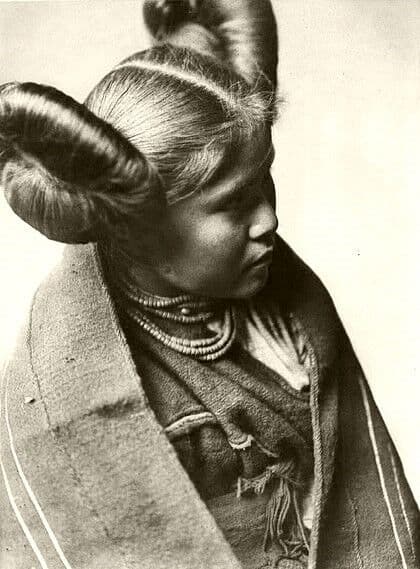
In areas where corn is cultivated, there are beliefs that relate the symbolism of fertility and well-being to the symbolism of the flute. Writer Carlos Castaneda noted that around 1541, the use of flageolets was common in the Corn Grinding Ceremony among the Tewa Pueblos (The Tewa are North American indigenous peoples who spoke the Tewa language and share the Pueblo culture. Their homelands are near the Rio Grande in New Mexico, north of Santa Fe). These rituals were performed by women, who used the sound of sharpening stones, dances, and songs to compose their ceremony, but the interesting thing was to identify the presence of a flageolet being played by a man seated at the door (Hammond-GP 1940).
Another example of the close relationship between the flute and corn, dated to a later period, can be found in a study by AM Stephen of an initiation ceremony that took place in the Hopi Flute Society:
“When a young man of this people is brought to see the flute altar for the first time, he must bring a handful of flour as an offering to the man he has chosen as ‘father’ or ‘master.’ The ‘father’ casts the offering upon the altar… On the fourth night of the ceremony the novice is initiated and receives the ear of corn, which symbolizes his protective ‘mother,’ and he holds this ear throughout the singing… Later this ear is placed in the house where this young man lives with his family. It ensures good food and health for the body, that is why a symmetrical ear is always the one chosen” (Stephen 1936).
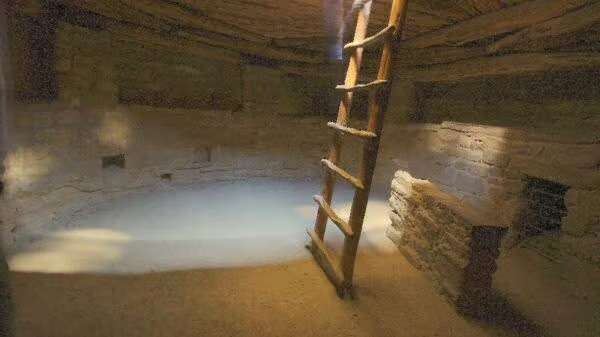
The Blue and Drab societies, which are now extinct, played a very important role in Pueblo culture. One of the main duties of these societies was to pray for rain and fertility, as well as for warm weather and good harvests. As the Pueblo Indians live mainly in a desert environment, the absence of rain was a threat to their physical existence. Thus, much of the rich ceremonialism of the Pueblos revolved around this concern. One of the most important events that took place in Pueblo culture was the Flute Ceremony, which occurred in August. The ceremony and mythology are closely connected. Secret rites were held in the ancestral rooms of this society; these ceremonies were not held in the kivas (Kivas are large circular underground rooms, used by the Pueblo peoples for their ceremonies), where most other ceremonies were held. The precise details of this ritual were known only to the priests who were the main performers of the ceremony and responsible for its transmission to the following generations of priests. The flute altar was a sanctuary covered with designs and a large number of items full of symbolism. On the flute altar was depicted the image of the Locust (Grasshopper, Kokopelli), the hunchbacked flutist known throughout the Southwest as the symbol of “healing” in the flute society. This intriguing figure is linked to warm weather, fertility, and even more to bravery. The various roles attributed to this character encompass many aspects of life: fertility, life, control of the weather for warmth, rains, good harvests, and war.
Among the Fox Indians, the flute was also a component of the “healing” bundle through the White Buffalo Dance. Dispelling storms is included among the various functions of this ritual.
It is interesting to note that the number four is always related to the flute and its supernatural meaning in rituals and myth. This relationship is expressed in various ways, such as in ceremonies where participants circle a place or object four times, a certain action is performed by four people at different points of a ritual, or some aspect or procedure that lasts four days. Besides being present in the most diverse forms in myths linked to flutes.
The Visual Appearance and Structure of the Flute
The visual appearance of the flute is an integral part of its symbolic role. However, due to the scarcity of material on this aspect, it is difficult to gain a sufficient understanding of the variety of design and color of flutes in North American indigenous cultures.
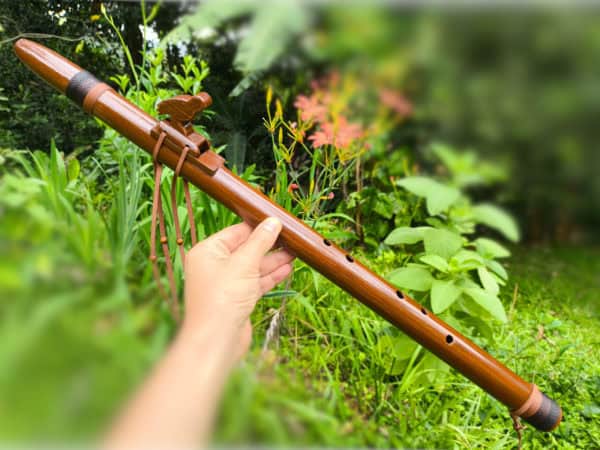
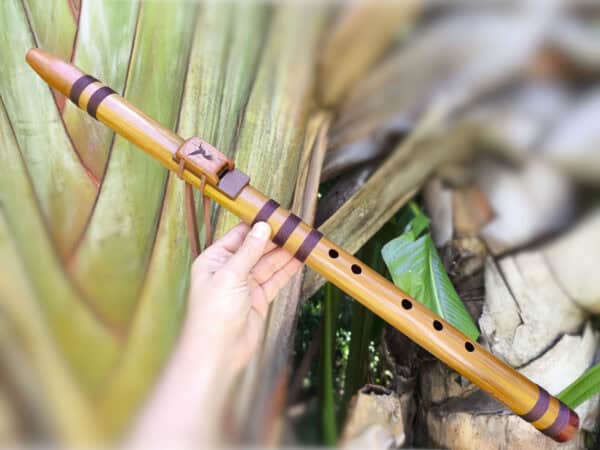
Among the main factors that determine the potential of a flute, we have the number of holes, which in the flutes of North American Indians is usually four to six. There are also flutes with three and seven finger holes, as well as some with extra holes at the bottom of the tube. But evidence as to the correct number of holes is very vague. However, one can speculate that the number of holes in some flutes is determined by symbolic rather than musical reasons. Since four fingers are more common, it is likely that the number four, once again, plays a symbolic role. In the myth “The Origin of the Flageolet” of the Mandan and Hidatsa villages. Grandmother, (character in the tale) who made a flute from a sunflower stalk, explains that “the seven finger holes represent the seven months of winter.”
Some flutes had holes added at the lower end of the tube. As with some Chinese flutes, these holes were not used for playing. It is unclear whether these extra holes were made for mere decoration or had some other function. It is not unlikely, however, that some indigenous villages were influenced by the Chinese. Merriam mentions the presence of Chinese influence in the latter part of the 19th century, when many Chinese came to western Montana. Flutes with these added holes can be found in several villages.
The distance between the holes seems to approximate the size of the hand and fingers of the maker or of those for whom a specific flute might be made. Merriam describes how a Flathead Indian, a flute maker, makes the holes: “… the craftsman places his fingers on the hollow tube in what seems to be the appropriate position and burns the holes into the wood …”
The question of the distance between finger holes needs further study. The holes in many flutes, especially those with three or four, are equidistant. In a six-hole flute, there are usually two groups, each composed of equidistant holes. In another example, Densmore speaks of a Yuman flute maker, Captain George: “he marked places for three finger holes where his finger rested most conveniently”
In his book “The American Indians and Their Music,” Frances Densmore briefly discusses the question of the position of the finger holes: “The Indians in all villages questioned by the writer said that the finger holes on the flute are spaced in a manner convenient for the hand of the flutist.” The sizes of flutes and the material of construction can vary greatly within a village; many different types of wood are used, including cedar, juniper, elderberry, reed, and so on. Some less common woods used are sunflower stalk, dried wild parsnip reed. Other materials used: ceramic (Pueblo), gun barrel (Apache), red pipestone (Sioux).
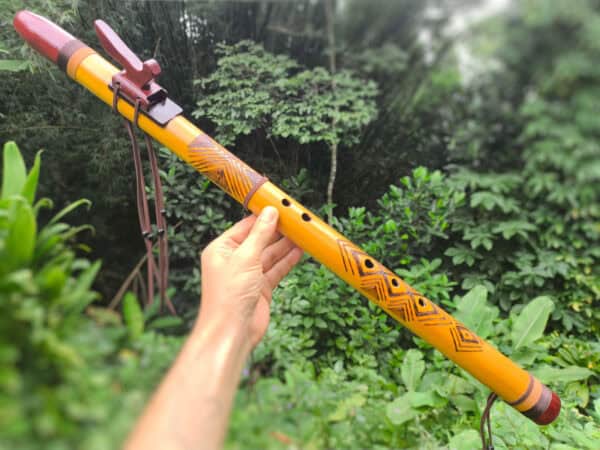
Color and design are among the most revealing visual aspects regarding the connection between the flute and its symbolic role. A large number of flutes described or collected by ethnographers and ethnomusicologists were painted in a variety of colors. Some colors, such as red, pink, black, yellow, and green, are particularly common. Colors are applied to flutes by staining or drawing specifically symbolic figures, such as arrowheads, zigzags (depicting lightning), the horned water serpent, and stars. Colors present a wide and complex variety of connotations. Each color can be linked to certain aspects of life and the universe. All directions of the world, for example, are represented by colors.
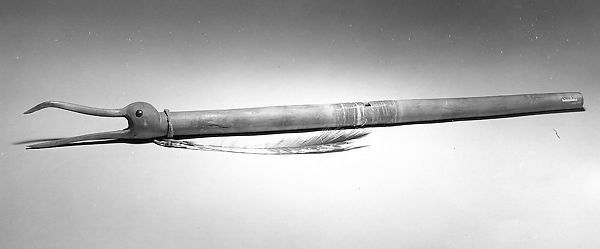
Whistle with the end carved in the shape of a bird’s head. The sound is generated by a stream of air hitting the sharp edge of a split feather piece placed over the opening on the side of the tube. These whistles are used in the ceremonial Heron dance.
Some of the geometric designs mentioned above are burned into the wood so that the black designs stand out against the lighter color of the wood. Another widespread tradition is the ornamentation of flutes with animal effigies. A Papago flute in the collection of the Metropolitan Museum of Art in New York ends with a bird’s beak. The Sioux courting flute has a bird’s head. The Great Twisted Flute of the Sioux is ornamented with the effigy of a horse and painted red on the inside of each hole. An Oglala flute on display at the Metropolitan Museum of Art in New York is decorated with a carved rabbit. At the Museum of the American Indian of the Heye Foundation in New York, Cheyenne and Winnebago flutes on display end with bird heads.
In the intricate American indigenous culture, animals symbolize certain aspects of life or attributes, such as bravery, successful hunting, and wealth. Therefore, it is not surprising to find animal effigies carved or mounted on flutes. Other ornamental and ceremonial devices often used include beads, shells, feathers, glass, metal chips, or even the attachment of small medicine bags.
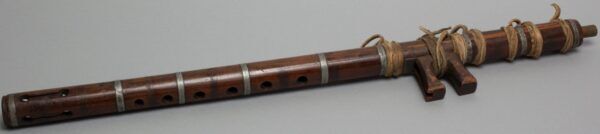
The previous discussion of the different elements that affect the construction and appearance of the flute supports the assumption that non-musical concepts greatly influence flute making. However, there is clear evidence that musical criteria also play an important role:
When analyzing the songs played on the flute, one notices that there is, in general, a uniform system in the musical style including scales. This probably would not have existed if its construction were entirely based on non-musical considerations. The strongest evidence that flute makers were concerned with the tones produced by their instruments is the fact that on many flutes a tuning block was placed to control intonation. A number of flutes to which a tuning block is attached are on display at the Museum of the American Indian in New York. The flutes in this collection with tuning blocks include those of the Blackfoot, Seminole, and Winnebago.
Throughout this entire study, we can perceive the strong presence of the flute in the culture of a large part of the indigenous peoples of North America and all its relationship with the sacred universe of these peoples. Demonstrating that all the variations present in these instruments, whether through the material from which the instruments are made, the number of holes, and even the painting and finishing, all these characteristics somehow relate to the supernatural beliefs or habits of the peoples.
References:
- The Flute and Flute Music of the North American Indians
- Tewa
- Kiva – Ancestral Pueblo Ceremonial Structures
- Winnebago, Native American Flute
- Native American Whistles – 19th Century Oglala Lakota, Sioux Peoples



Priceless information. Endless gratitude to Chelyl Jennings from Texas, for the
Interesting article sent to me
Much obliged
Grandma Elena from Athens Greece🇬🇷