



 $
$“Music is the beginning and end of the universe. All actions and movements made in the visible and invisible world are musical.” (Hazrat Inayat Khan, Sufi master)
“The flute is as old as the world.” (Ancient American Indian saying)
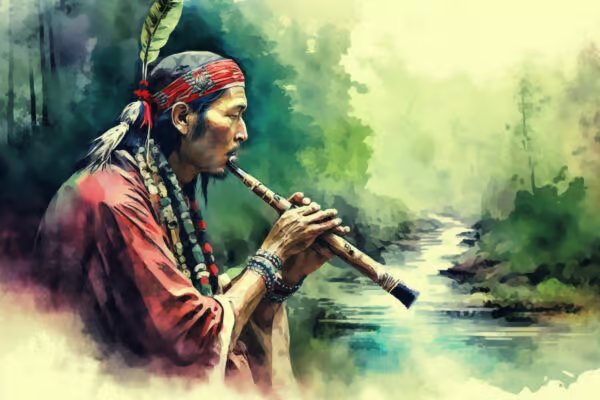
A study conducted to explore the healing potential of music played through the Native American Flute on various cases of deep trauma presented an interesting point of view about flutes, the sacred music of ancient peoples, and their deep respect for knowledge coming from ancestors and invisible subtle worlds. The research demonstrated that there is an unexplained field within this ancestral musicality that definitively seems to affect layers of the subconscious and assist in the treatment of traumas and disorders initiated during childhood.
These traumas trigger a disorder called “dissociation” in which the individual presents a state of deep disconnection from the world around them, like when we claim to feel “spaced out” with difficulty concentrating, anxious, but this disorder is a permanent state that can last a lifetime and trigger various symptoms such as panic, depression, outbursts of anger, nightmares, and even amnesia.
Healing
In ancient cosmologies, healing means returning to wholeness. It is about facilitating the return to harmony and balancing the internal relationship, interconnecting this relationship with our relationship with the whole, with everything that can be seen and everything that cannot be seen: the individual (body, emotions, thoughts, and spirit), nature, and the cosmos itself.
Music
The belief in the power of music is universal. Music is identified with beliefs about the creation of the world and has been used for prayers and healing in ancient mystical and indigenous traditions throughout times and cultures. Shamans, philosophers, and mystics see music as a balancing, unifying, and healing force. The use of music for healing can be traced back to the beginning of recorded history.
Music and Trauma
A nurse, Margaret Anderton, at the end of World War I, worked with wounded Canadian soldiers. She described treating “war neurosis” with music. She stated that “memories were brought back to men suffering from amnesia; acute temporary insanity eliminated; paralyzed muscles restored.” She described one particular captain, “who was thrown into the air and then buried in the rubble when a bomb burst and was never able to remember even his own name until music restored him”. This early work was done with veterans who would probably now be diagnosed with Post-Traumatic Stress Disorder, exhibiting symptoms of dissociation.
It was after World War II that the therapeutic use of music was formally named “music therapy”. It was used to deal with combat trauma, successfully used in reducing depression and helping in the return of dissociated memories.
“Music is the deepest non-chemical medicine” (Oliver Sacks (1933 – 2013) – Neurologist)
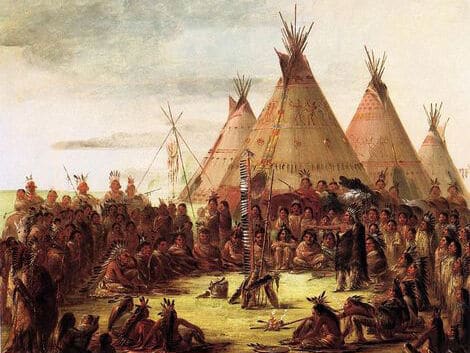
Music in Ancient Spiritual and Indigenous Traditions
To describe the importance of music in these ancient cosmologies, it is important to recognize the different beliefs and their myths about the creation of the world. In this way, we identify the universal concept that the world arose from “sound”.
“One Word, and the whole Universe came into existence.”
Granth Sahib (Sacred scriptures of Indian Sikhism)
“In the beginning was the Word, and the Word was with God, and the Word was God.”
Christian Bible
“And God said ‘Let there be light’ and there was light”
Jewish Old Testament
“Consequently, with that Word, with that Being, he brought forth this entire universe, everything that exists.”
Hindu Upanishads
There are many Native American tribes and therefore many beliefs about creation. However, there is a belief in many American Indian traditions that this world was “brought into existence by sacred songs”. During the Hopi Flute Ceremony, there are songs for “emergency” situations in the world. When the “emergency songs” are sung, reed flutes are used. It is important to note that both “sacred music” and the “flute” are connected in this auspicious ceremony.
From the beginning, sound has been considered sacred and imbued with special powers. Everything is created from sacred sound, everything is sacred, everything is alive, and everything has a spirit and its own sound.
Natalie Curtis, who studied Native American music in the late 1800s, described that all things possess a “soul” and everything has its own sound or music.
Hazrat Khan, a Sufi master and mystic, also described that each person has their own sound. Human beings, both in physical form and in spirit, are a sound or a music.
As sacred sound is part of the beliefs about the creation of the world, and sacred sound is that of which all things are made, it is understood that sacred sound can facilitate healing through the return to balance and harmony of our being, as a sacred unity with the planet. Sound becomes the unifying force of healing.
In the description of a Navajo healing ceremony, a concept of Unity is illustrated:
“Physical and mental illness is the result of disturbance of harmony. On the other hand, the cure for illness is to restore the patient’s harmony. This is the goal of the Navajo ceremony – to seek the preservation or restoration of harmony” ––Bahti
The flute, in many ancient stories, legends, and traditions, has been associated with magic, mysticism, and the capacity for transformation. It is easy to remember “The Pied Piper of Hamelin”, Mozart’s “The Magic Flute”, Krishna and his flute. The flute’s ability to induce trance or alter states of consciousness was described by Plato and Aristotle. Whistles and bone flutes were discovered in the temple of Apollo at Delphi, and Apollo is considered a god of music and a god of healing.
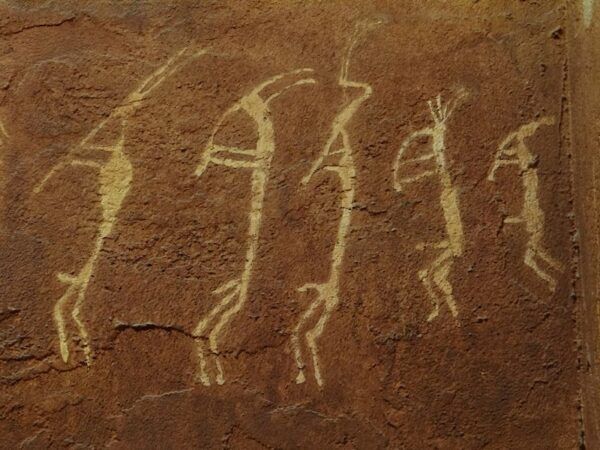
There is an old Native American saying: “There was always a flute, just as there were always young people. The flute is as old as the world.” Archaeological discoveries may give credit to this saying, as to this day the flute is documented as the oldest instrument discovered.
There is a well-known image of a hunchbacked flute player depicted in ancient rock art of North America. This image has been described as the “rain priest”, “deity”, and “shaman”. All these beings are identified as having supernatural abilities.
In myth, legend, and practice, the Indian flute is described in terms of the sacred, healing, transformation, and love. In a Dakota legend, the flute was brought to humans by the supernatural “Elk People”. It was “imbued with the sounds and power of all living things…” and expressed “the divine mystery and beauty of love”.
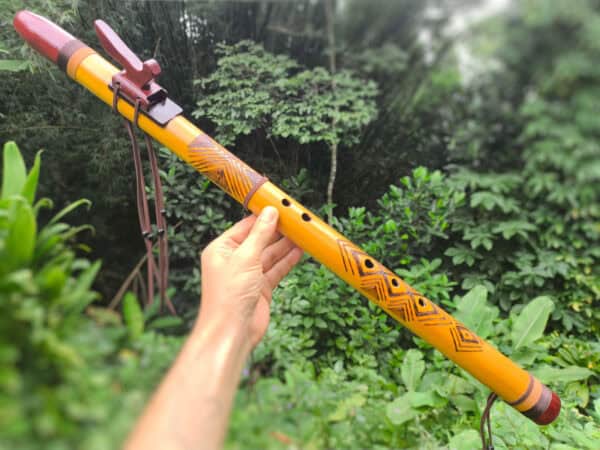
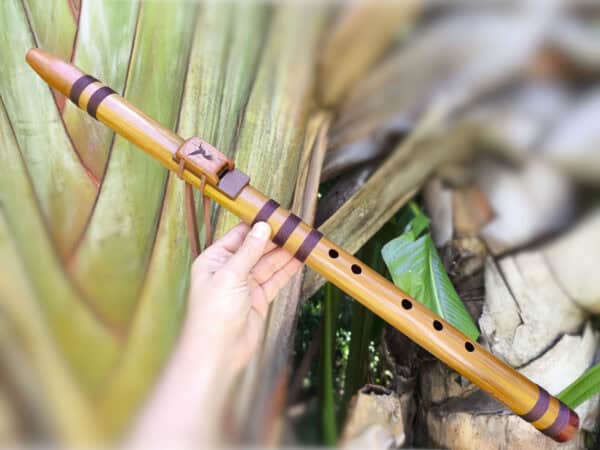
The Native American flute is a unique musical instrument, according to legend the oldest. It is imbued in ancient indigenous and mystical spiritual traditions; beliefs include the flute in the power of sacred music. It is these songs, these prayers, that are used to maintain and restore the delicate balance of harmony when it becomes unbalanced. Healing with “songs” and prayers is keeping in harmony something as vast as the cosmos and seemingly as limited as an individual.
The Research
This research was conducted with adults over 18 years old, both men and women. One group presented different types of dissociative traumas, and the other group was composed of adults without traumas. For both groups, tests were conducted with a specific sacred music played on the Native Flute and another “placebo” new age music.
RESULTS OBTAINED (Participants’ responses when listening to the native flute)
“It felt like I was flying…”
“It took me to the forest…”
“… tied everything together.”
“How can people feel like this? I wish I had this instead of Xanax… I feel so good. It felt like the feeling when I took morphine… heaven… something totally peaceful. It must be like when people die.”
A participant with Dissociative Disorder described having recurring and bothersome dreams of bears chasing her. During the experience, she described that while listening to the flute music, the bears began to chase her again and she ran, but this time they caught up with her. She stated her surprise and happiness that when they caught her, they held and protected her.
Shamanic Characteristics Identified in the Research
There are four characteristics of the work done through shamanism, as described in Eliade’s academic work.
- Journey
- Connection with nature
- Relationship with Spirit
- Space-time phenomena
The responses obtained from the analyzed participants related to shamanic characteristics:
Journey:
“It was like being on a trip…”
“It took me to the forest at night. I had animals protecting me…”
Connection with Nature:
“I was in nature, I was of nature, like a part of it,… a tree.”
“I was in contact with nature, the sky, the wind, like an evocation of all those things.” “As if I were a wolf howling at the moon.”
Related to Spirit:
“… I felt spiritually touched.”
“… It felt like a call to a ceremony.”
A participant with dissociative disorder reported hearing the words “Go home, go home” and “It’s safe… so the body can feel peace”. When asked: “What do you believe it is: go home?” She replied: “It was about my soul… for it to come home.”
Space-time phenomena:
A participant from the research group without traumas reported having returned to a life lived in Africa, one hundred and fifty years ago, during her mother’s funeral. This participant seemed to have African-American descent, although she said she had never been to Africa. She described the flute music as “ceremonial” and how the experience was “beautiful”. She repeated how peaceful and beautiful the “ceremony” was.
Anthropological Correlates
There seems to be an anthropological parallel in the concept of “soul loss”, present in various indigenous cultures of the world, with the dissociative disorder linked to trauma. For indigenous culture, soul loss can be partial or total. In psychology, this is described as the loss of memory, affect, or sense of personal identity. In indigenous cultures, the process of reconnecting to one’s self is often aided by a shaman, in soul retrieval practices.
Shamanism, considered one of the oldest forms of healing, continues to use “sounds” and “music” to communicate with and access the spirit world, and this kind of use of music for healing is still practiced today in various tribal and non-technological societies around the world.
The Importance of the Musician
How significant is the flute player? A significant number of research participants reported having previously heard other Native American flute music, describing that this particular music affected them differently, more actively. The extent of the healing effect has something to do with the flute player, their attitudes and intention, and seems to be something beyond technique and playing ability. Further comparative research will help in this determination.
Hazrat Khan, a Sufi mystic, wrote about the influence and characteristics of sacred music. He also wrote about musicians. “The effect of music depends not only on proficiency, but also on the evolution of the performer. Its effect on the listener is in accordance with their knowledge and evolution; for this reason, the value of music differs in each individual.”
Conclusion
There are significant ethno-musicological implications of the study to be explored further. But through this experimentation, it was identified that through what can be qualified as shamanic or sacred sound, a return to wholeness (i.e., interconnectedness) can be potentiated by experiencing different states of expanded consciousness. The search for wholeness can be guided by a psychologist or through the search for subtler paths. Sound touches deeply, going far beyond words and intellect. Through all this study of music and ancestral flutes, the conceptual paradigm of dissociative disorder can be expanded, being understood not only as a psychological orientation, but also as a spiritual misalignment oriented within a cross-cultural worldview. Dissociation, the human mind, concepts of spirituality, and consciousness can begin to be explored and understood in ways previously unforeseen, through sound.
Reference:
The effects of sacred/shamanic flute music on trauma and states of consciousness – Lenore L. Wiand, Ph.D.


Knowledge of Native Flute
When breath becomes sound: breathing, flute, and inner state
See MoreJun
The flute as a practice of presence: playing is also listening
See MoreMay
Improvising on the flute: where to start without getting stuck
See MoreMay
How to improve the sound on the flute with small adjustments
See MoreMay
Breathing on the flute: the most common mistake that blocks the sound
See MoreApr
First sounds on the flute: what really matters at the beginning
See MoreApr
Which flute to choose to start? An honest guide for beginners
See MoreApr
Jazz, Modal Music and the Art of Improvisation
See MoreJun